Skip to content

Groups

Personal Group

When you sign up for Qaack you will be assigned a personal group. You can select it on the sidebar.

groups

Creating a Group

You can create additional groups to share repositories and variables with your team.

You can add members directly while creating the group: start typing a name or email and pick from the suggestions (the search looks up existing users on this instance), or type a full email and press Add. The email is validated against existing users right away, so you'll know immediately if it doesn't match anyone. You can also paste a comma or space-separated list of emails to validate and add them all at once. Use the admin toggle on the input to add a member as an Admin instead of a plain Member. You (the creator) are always added automatically as the group's Owner.

Member Permissions

Group access and repository access are separate layers:

  1. Group role (Owner / Admin / Member) — who can manage the group itself and create, delete, or transfer repositories.
  2. Repository maintainer — optional, per-repo access for a group member to edit that repository's settings without becoming a group admin. See Repository maintainers.

Group roles

Every group member has one of three group permission levels: Owner, Admin, or Member. The user who creates a group is its Owner.

  • Owners can promote or demote any member, including other admins. Only an owner can change another owner's role.
  • Admins can promote members to admin and demote other admins, but cannot change an owner's role.
  • Members can view the group, its repositories, and environments. They cannot change group settings. To edit a specific repository's settings they need to be a repository maintainer of that repo (or be promoted to Admin/Owner).

Who can do what — group actions, repository settings, environments, and maintainers — is in the matrix below.

Permission matrix

Maintainer is not a group role. The column means a group Member who was granted maintainer on that repository. Group owners and admins already manage every repository and do not need a maintainer row.

Action Owner Admin Maintainer (that repo) Member
View group, repos, and environments
Rename or delete the group
Add / remove members; change roles ✓¹
Create / edit / delete group variables
Create / delete / transfer a repository ✓²
Edit repository settings³
Add / remove maintainers
Delete a reusable environment
Sync git refs; spawn, build, rebuild, or delete environments
Service logs, console, and exec

¹ Admins cannot change an owner's role. Only an owner can change another owner's role.
² Transfer also requires Owner/Admin of the destination group.
³ Name, TTL, qaackfile, webhooks, IP allowlist, private registries, repository variables, GitLab token, and similar repository settings. Members can open repository settings read-only.

Need someone to own one repo only?

Keep them as a group Member, then grant maintainer on that repository under Repository settings → Security & Access. Full details: Repository maintainers.

Group Settings

You can add group members and manage the group variables.

group-settings

Adding Members

The "Add member" screen lets you stage several members (typed or picked from autocomplete, or pasted as a comma or space-separated list) before sending the invites. Suggestions come from users already on this Qaack instance. For each member you can choose their role:

  • Leave admin unset (or false) to add them as a plain Member
  • Set admin to true to add them as an Admin

If a staged member can't be invited (for example, they're already in the group), they stay in the list with the reason shown, so you can remove them or retry — the rest are invited normally.

Updating Permissions

You can promote or demote any member via the members settings panel. Owners cannot be demoted by admins — only another owner can change an owner's role.

Members who are repository maintainers show a wrench icon next to their row; hover it to see which repositories they maintain (each name links to that repository's Security & Access settings). Manage those assignments from each repository's Security & Access settings.

Deleting a Group

Admins and Owners can delete a group from group settings. Deletion is permanent and cascades: every repository in the group (including its environments), plus the group's configurations and variables, are deleted with it. To confirm, you must type the group name before the delete can proceed.

Group Repositories

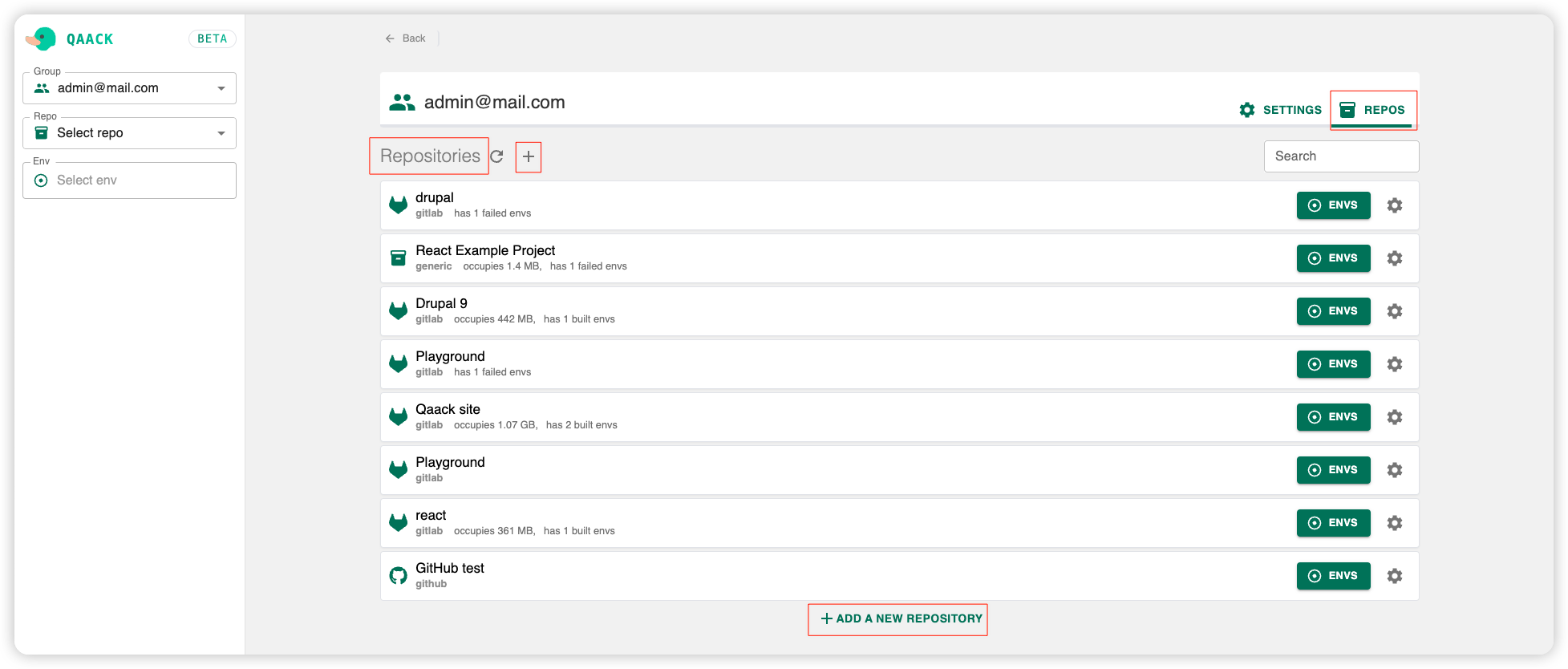
You can see the repos of the group and add new ones. Adding, transferring, and deleting repositories requires Admin or Owner access.

Editing an existing repository's settings (qaackfile, variables, webhooks, and so on) can also be done by a repository maintainer of that repo — they do not need group Admin.
group-repos